The Fort Phase is the initial basic training for NCR troopers. During the Fort Phase troopers learn to manage their gear and weapons, learn fort, team and trail procedures and most importantly, how to function in their team roles. Trainees choose an initial team role, medic, radio operator or rifleman, and learn how to function in that role on a Ranger Rifle or Support Team.
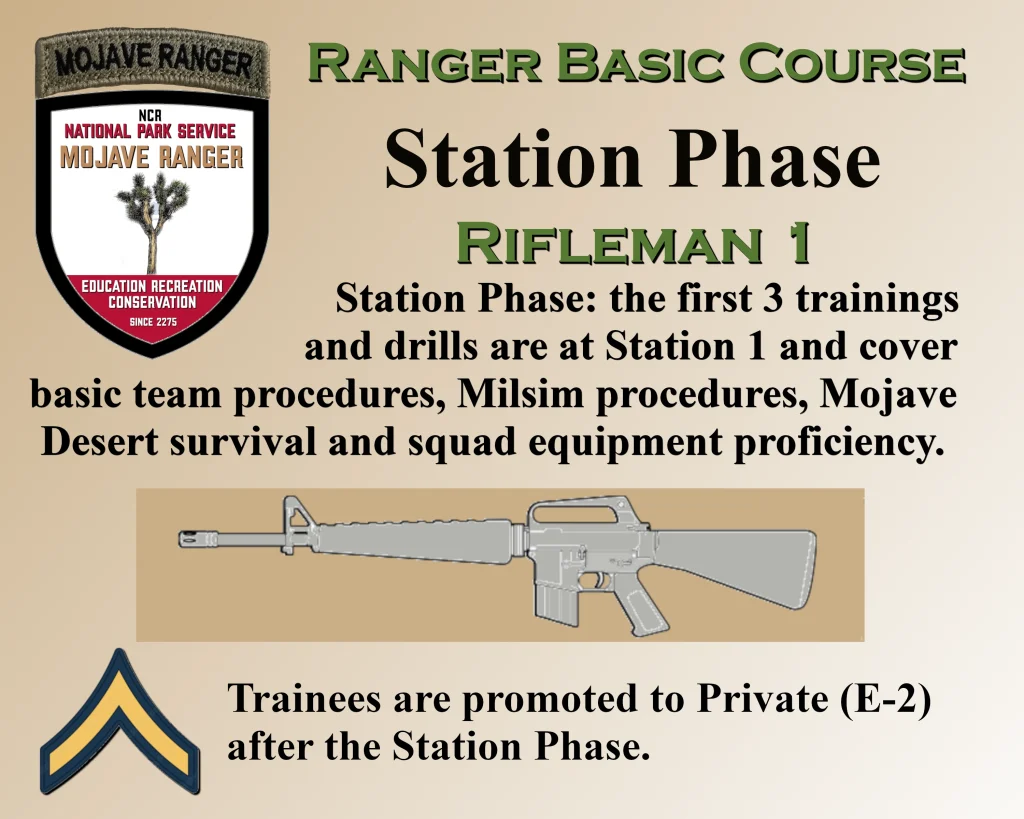
Trainings 1 and 2 (January and February) cover how to operate and maintain the FRS radio, airsoft NCR Service Rifle, Hi-Power pistol and airsoft grenade, introduce trainees to their team roles and team assignments and the beginnings of the Mojave Desert survival training. After Drill #2 trainees should be checked off on enough of the skills in the task book to be able to assist with fort defense during a raider attack.
Training #3 (March) covers team tactics and trainees learn to work as a team to complete tasks, assault obstacles and recover injured troopers under fire. Training #3 also certifies trainees on the FRS team radio which is used for team tactical communications.
On-the-Job-Training
Training and Drill #1 are inside the fort grounds. On training 2, teams of trainees make a short hike to a nearby cache site, with team training happening on the trail. Training 3 takes the trainees slightly further afield, yet still near the fort, on a series of map/compass objectives to training stations where trainees learn team fire and maneuver drills, trail security and patient extraction.
After Drill #3 trainees are promoted to Private E-2 and are ready to start the Patrol Base Phase.
 Rank and Military Courtesy
Mojave Rangers are a volunteer civilian security and emergency services unit operating in a hostile area under Martial Law and led by NCO’s and Officers from the NCR Army Special Forces. Mojave Rangers do not hold rank in the NCR Army and function as local volunteers exactly like a pre-war volunteer fire department or rescue squad.
Mojave Rangers maintain basic military courtesy, and courtesy in general, but do not salute or perform close order drill, beyond ceremonies or inspections, and are not expected or required to participate in larger NCR Army operations outside their local Area of Operations.
Close Order Drill was developed to move large groups of heavily-armed, semi-trained men with loaded weapons safely and efficiently from one place to the next. Mojave Rangers have a basic inspection formation which is also used for rank promotion and other ceremonies and a voluntary Color Guard for ceremonies.
The salute was developed as a way for warriors to acknowledge one another and stems from the raising of the visor on a Knight’s helmet to signify that they aren’t about to attack one another. In modern military tradition troopers salute officers when passing outdoors and for other reasons.
Troopers do not salute in combat zones because saluting identifies the officers for snipers. Until the completion of the NCR’s Mojave Pacification Campaign the Mojave is a very active and hostile combat zone.
Promotion Ceremony
The Fort Phase ends with a short promotion ceremony where trooper’s success is acknowledged and trainees are promoted to Private E-2 and awarded their first rank insignia.