
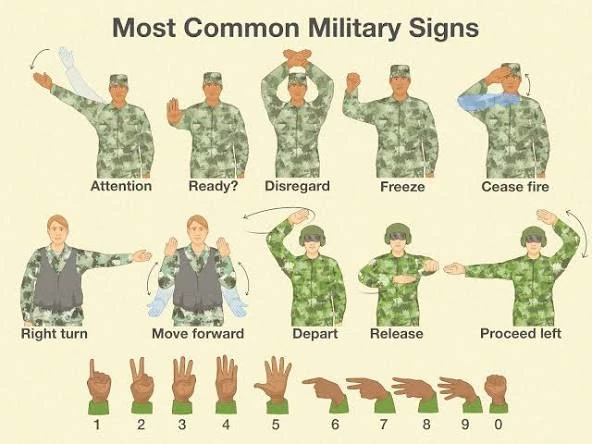
 Tactical Hand Signals
Tactical hand signals are non-verbal, visual cues used to maintain noise discipline, stealth, and control during combat, training, or when radio communication is impossible. They ensure teams can coordinate movement, indicate enemy positions, and pass information over distances without shouting, crucial in high-danger scenarios.
Core Tactical Hand Signals
- Halt/Stop: Raise your hand above your head, palm facing forward.
- Freeze: Make a closed fist and raise it high.
- Move Out/Follow Me: Extend the arm and wave it inward towards the body.
- Enemy Sighted: Point two fingers from the eyes towards the target location.
- Down/Cover: Extend the arm at a 45-degree angle, palm down, and move it down and up.
- Rally Point: Tap the chest, then point downward.
- Double Time (Speed Up): Pump your fist in an upward motion.
- Slow Down: Extend the arm horizontally to the side, palm down, and move it up and down.
- Chemical/Biological Attack: Extend both arms with fists, then bend arms to shoulders repeatedly.
Context and Usage
- Unit SOPs: While standard signals exist in Army Field Manuals (FM 21-60), many units adopt specific Standard Operating Procedures (SOPs) for their team.
- Limitations: These signals are vulnerable to misinterpretation, reduced visibility, and enemy interception.
- Range: When distance increases between soldiers or vehicles, flags or flashlights can be used to extend the reach of the signals.
Key Considerations
- Practice: Effective use requires constant team practice, as inconsistent signals can cause confusion.
- Context: Signals are highly contextual and should be precise, avoiding partial or ambiguous movements.
Tactical hand and arm signals are a vital form of non-verbal communication used by the Army to maintain noise discipline and stealth during missions. These signals allow leaders to control movement and coordinate actions silently when verbal communication is risky or impossible due to distance or environmental noise. Standardized across the U.S. Army in manuals like TC 3-21.60, they cover everything from basic movements to complex vehicle maneuvers.
Core Tactical Signals
These foundational signals are among the first taught to new recruits during Basic Combat Training.
- Freeze: Raise a clenched fist to head level. This indicates to stop immediately and stay alert.
- Halt: Raise the hand upward with the palm facing forward and the arm fully extended. This signals to stop movement.
- Enemy in Sight: Point the weapon or index finger in the direction of the enemy. Some variations involve making a circle with the thumb and pointer finger.
- Assemble: Raise the arm vertically above the head and make large horizontal circles with the open palm.
- Follow Me: Extend the arm to the rear with the palm up, then swing it overhead and forward in the direction of movement.
Movement and Combat Commands
- Increase Speed / Double Time: Thrust a clenched fist upward multiple times from the shoulder.
- Slow Down: Move an extended arm down and up repeatedly.
- Take Cover: Sweep an extended arm down towards the side from a high angle.
- Cease Fire: Swing the forearm up and down while holding the hand, palm out, in front of the forehead.
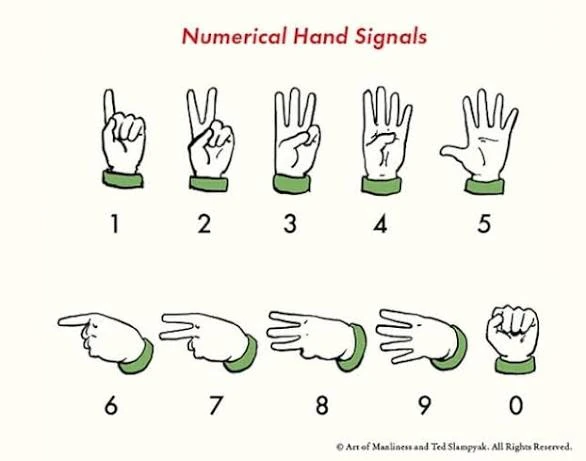 Numerical Signals
Due to a hand often holding a weapon, a specific one-handed counting system is used, involving vertical fingers for 1–5, horizontal fingers for 6–9, and a clenched fist for 0.
Specialized Communication
- Rally Point: Touching the belt and pointing to a location.
- Head Count: Tapping the back of the helmet.
- I Don’t Understand: Shrugging shoulders with palms up or raising arms.
- Message Acknowledged: A thumbs-up gesture.
While standard, units often adapt these signals through Standard Operating Procedures (SOPs) to fit specific mission requirements.