Shoot: Lesson 1 – Team Roles
Explain your starting team role: Rifleman, Medic or RTO
 The Rifleman
The rifleman is the foundational, most common, and highly versatile infantry role within a fire team or squad, designed to handle general-purpose combat, reconnaissance, and specialized tasks. As the backbone of a fire team, they provide consistent, accurate fire support while supporting specialized roles like automatic riflemen, medics, and anti-tank (AT) gunners.
A Rifleman is the fundamental building block of a squad or fireteam. Often described as the “backbone” of infantry operations, they are versatile soldiers who focus on general-purpose combat rather than a single specialized tool.
Key Responsibilities and Roles
- Versatile Combatant: Riflemen are primarily tasked with engaging enemy infantry with precise, accurate shots (direct fire) at close to medium range.
- Ammo Bearer/Supporter: They frequently act as the assistant to specialized roles, carrying extra ammunition (for the Automatic Rifleman or Machine Gunner) or anti-tank rockets (for AT gunners).
- Scout: They are often used as the “point man” to lead the team, scouting ahead to identify targets and gather intelligence for the Team Leader.
- Adaptable “Pack Mule”: They are often the lowest-ranking member and least encumbered by heavy duties, allowing them to carry additional equipment needed for the mission, such as extra grenades (for “grenade rain”) or demolition gear.
- Backup Leadership: They must be proficient in all squad tasks, ready to assume the role of the automatic rifleman or team leader if they fall.
Characteristics and Loadout
- Primary Weapon: Generally equipped with an assault rifle (e.g., M4, M16, C7) often outfitted with optics, holographics, or iron sights.
- Versatility: Capable of clearing buildings, defending static positions, flanking, and conducting reconnaissance.
- Suppression: While not having the high output of a machine gunner, they contribute to suppressing enemies by maintaining accurate fire on known positions.
Core Responsibilities
The primary mission of a rifleman is to locate, close with, and destroy the enemy through fire and maneuver. Their specific duties include:
- Direct Fire Engagement: Providing accurate, well-aimed lethal fire against point targets.
- Maneuver & Support: Moving quickly to capture objectives while providing cover for specialized members like medics or engineers.
- Security & Scouting: Scanning for threats, spotting enemy movement, and maintaining 360-degree security for the team.
- Specialist Support: Often acting as an “assistant” to other roles, such as carrying extra belts for the Automatic Rifleman or munitions for the Grenadier.
- Tactical Utility: Handling general tasks like navigation, radio communication, and transporting common squad equipment.
Team Medic
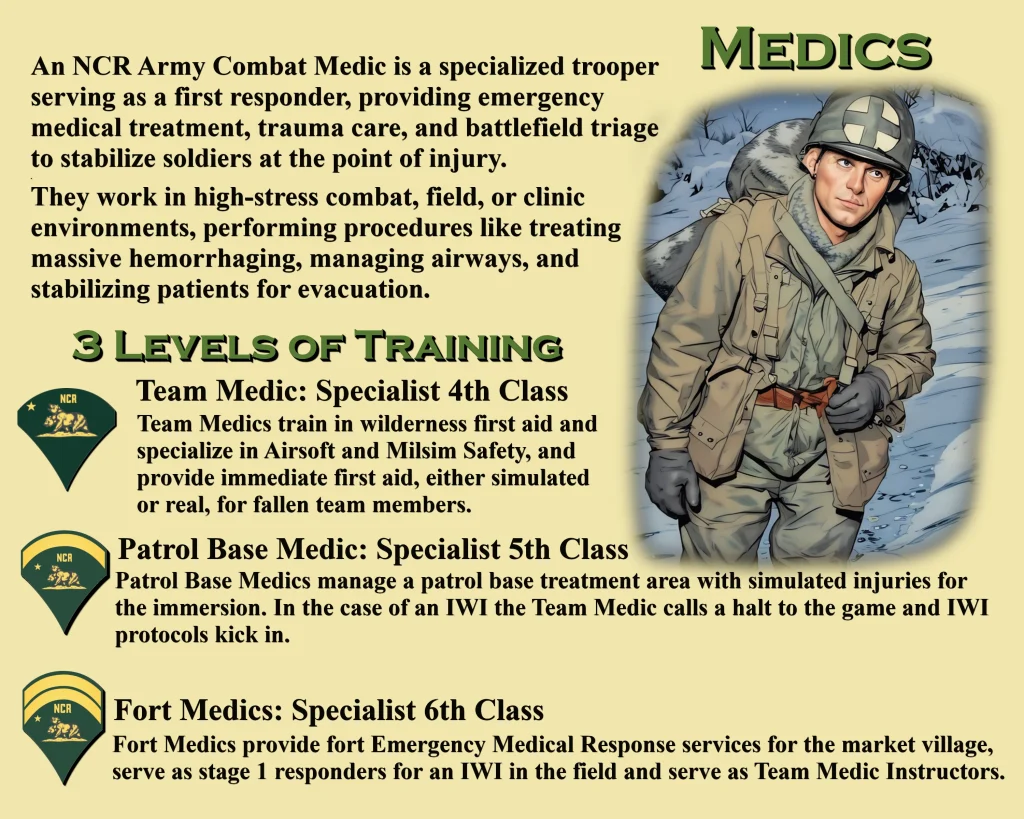 An Army Combat Medic Specialist (MOS 68W) fulfills a dual role as both a trained lifesaver and a soldier, often referred to as “Doc” by their unit. Their primary responsibility is to provide emergency medical treatment at the point of injury (combat) or in training environments, stabilize patients, and manage evacuation to higher levels of care.
Medics often carry both their personal weapons (for self-defense and defending their patients) and a medical aid bag, bearing a heavy load of equipment while ensuring their soldiers’ health.
Army Medics, officially known as 68W Combat Medic Specialists, fulfill several critical roles within a military team, ranging from frontline emergency care to administrative health management. Their duties shift depending on whether they are “on the line” with a combat unit, working in an aid station, or stationed at a hospital.
Key Team Roles and Responsibilities
- Combat/Line Medic: Embedded directly within combat units (infantry, armor, etc.), these medics are responsible for treating combat trauma, such as hemorrhage control, airway management, and stabilization under fire.
- Aid Station/Treatment Medic: Operates within a Battalion Aid Station (BAS) or Role II facility, providing further triage, primary care, minor surgical procedures, and monitoring patients before further evacuation.
- Evacuation Medic: Member of a Medical Evacuation (MEDEVAC) crew (ambulance, helicopter), focused on evacuating casualties from the “point of injury” to medical facilities.
- Trainer: Trains other soldiers in Combat Life Saver (CLS) techniques and Tactical Combat Casualty Care (TCCC) to provide self-aid and buddy-aid.
- Medical Facility Staff: Works in hospitals or clinics to perform patient care, manage medical equipment, and run daily sick call.
Core Competencies
- Triage: Making life-or-death decisions on patient priority in high-stress, mass-casualty situations.
- Primary Care: Managing illnesses, conducting screenings, and administering medications.
- Equipment Maintenance: Maintaining medical supplies, aid bags, and, in some cases, armored vehicles.
Core Team Roles
- First Responder & Triage: Medics are the primary personnel responsible for immediate life-saving care at the “point of wounding”. They assess injuries, prioritize patients (triage), and stabilize them in high-pressure situations.
- Tactical Soldier: Medics are “soldiers first”. They carry standard combat gear and weapons, such as an M4 rifle or M9 pistol, and must often suppress enemy fire before they can safely render aid to their team members.
- Evacuation Specialist: They manage the movement of casualties from the battlefield to safer treatment areas, often operating ambulances or coordinating with helicopter medevac crews.
- Medical Instructor: Medics are responsible for training their fellow soldiers in basic life-saving skills, such as the Combat Life Saver (CLS) course, ensuring the whole team can provide initial “buddy aid” if the medic is busy.
- Health & Readiness Manager: In non-combat settings, they monitor their unit’s overall health, managing medical records, overseeing supply inventories, and advising leadership on hygiene and disease prevention.
Specialized Team Placements
Depending on the mission, a medic may be assigned to different elements:
Line Medic: Embedded directly with an infantry platoon; they do everything the riflemen do while carrying a heavy medical aid bag.
Patrol Base Medic: Located at a Role 2 Aid Station, these medics work alongside Physician Assistants (PAs) and doctors to provide more advanced stabilization and minor procedures.
Fort Medic: Highly trained roles like the 18D (Special Forces Medical Sergeant) or SOCM provide advanced clinical and surgical care in remote, independent environments.
Team RTO
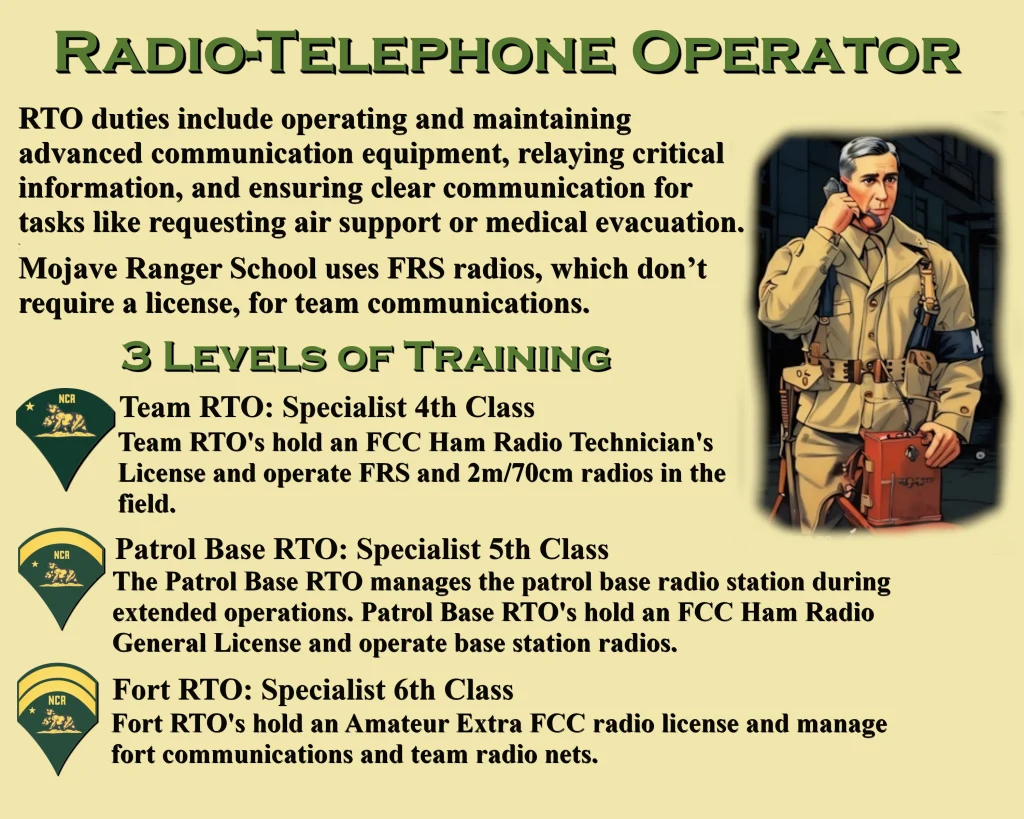 A Radio Telephone Operator (RTO) in the U.S. Army acts as the vital communication link between a platoon, company, or higher headquarters. Typically, the RTO is assigned to the Platoon Headquarters, working directly with the Platoon Leader (PL) or Platoon Sergeant (PSG). In the Army, an RTO (Radio Telephone Operator) is a critical role responsible for maintaining secure communication between a unit in the field and its higher headquarters. While traditionally a position at the Platoon Headquarters level, RTOs can also be found at the company and battalion levels.
Core RTO Team Roles and Responsibilities:
- Operating and Maintaining Communication Equipment: Ensures all radio equipment is functional, including setting up antennas, managing radio frequencies, and securing the radio.
- Communicating with Higher Headquarters: Maintains constant, secure communication, informing the platoon leader if contact is lost.
- Information Management: Assists the Platoon Leader with managing critical information, taking notes, and recording reports (e.g., SITREPs – Situation Reports, SALUTE reports).
- Relaying Messages and Reports: Processes, relays, and tracks critical information, such as MEDEVAC (Medical Evacuation), call for fire, and CAS (Close Air Support) requests.
- Maintaining Situational Awareness: Keeps the commander informed of the team’s position and status.
Specific Tasks and Duties:
- Battery and Signal Security Management: Monitors battery levels and manages COMSEC (Communication Security) devices.
- Field Expedient Antenna Expertise: Is proficient in constructing antennas to ensure communication in difficult terrain.
- Record Keeping: Maintains logs of all incoming and outgoing transmissions, including using DA Form 1594.
- Combat Load Management: Carries the primary radio along with full rifleman combat gear, requiring high endurance.
Role in the Team Structure:
Team RTO: Usually stays in close proximity to the Platoon Leader.
Patrol Base RTO (FO RTO): Works with the Forward Observer to manage artillery support.
RTO/Rifleman Hybrid: When not actively operating the radio, the RTO operates as a rifleman.
Core Responsibilities
- Establish Communication: The RTO ensures constant communication with higher commands and re-establishes contact immediately if lost.
- Expert Knowledge: They are subject matter experts in radio procedures, report formats (such as MEDEVAC, Call for Fire, or SITREPs), and constructing field-expedient antennas.
- Information Management: They assist leaders by sifting through incoming messages to keep them situationally aware and maintain detailed logs of all radio traffic.
- Equipment Maintenance: They are responsible for the preventive maintenance and repair of communications equipment, including managing battery utilization during operations.
- Tactical Mobility: RTOs must carry heavy specialized gear—often a backpack transceiver with long antennae—while maintaining the same pace and rifleman skills as the rest of the unit.
Team Context
Platoon Headquarters: The RTO typically operates as part of a three-person headquarters element alongside the Platoon Leader (PL) and Platoon Sergeant (PSG).
Forward Observers: Artillery teams (13F) often have their own specialized RTOs who focus exclusively on communicating fire requests.
MOS Designations: While any soldier can be assigned the RTO role (often an 11B Infantryman), it is frequently filled by specialized Signal Support Systems Specialists (MOS 25U).