The Ranger Basic Course is a year-long Milsim training course that trains medics and radio operators from a fort in the Mojave Desert. Ranger Basic has 3 phases,
 Fort Phase: the first 3 trainings and drills are at Fort Edwards and cover basic team procedures, Milsim procedures, Mojave Desert survival and squad equipment proficiency. Trainees are promoted to Private (E-2) after the Fort Phase.
- Patrol Base Phase: the second 3 trainings and drills cover patrol base operations. Trainees operate away from the fort on radio relay stations and support bases. During the Patrol Base Phase trainees learn to bivouac away from the fort and operate during the dawn and dusk hours (crepuscular, like coyotes) and rest and train during the heat of the day. Trainees are promoted to Private First Class (E-3) after the Patrol Base Phase.
- SAR Phase: During the Search & Rescue Phase trainees learn to operate with either Ranger Troop 4 or OpFor and participate in the weekend operations at Fort Edwards. SAR Phase includes night operations from a patrol base or the fort. After the SAR Phase trainees can attempt the Expert Rifleman Challenge and earn the Expert Rifleman Bar, and bonus.
The Ranger Basic Course is 10 monthly 4-hour trainings and drills that cover,
- First aid: the 10 first aid trainings cover,
- Wilderness First Aid
- Stop the Bleed
- Tactical Combat Casualty Care
- Radio: the 10 radio trainings cover,
- FRS team radios
- 2-meter/70cm hand-held and mobile radios
- Radio triangulation, radio nets & emergency communications (EmComm)
 Basic Infantry Skills: the 10 BIS trainings cover,
- Basic land navigation
- Infantry squad skills for airsoft
- Patrolling and patrol formations
- Patrol base operations
- Shoot Move, Communicate (SMC): the 10 SMC trainings cover,
- Airsoft gun safety
- Airsoft gun drills
- Squad drills
- Mojave Desert Survival: the 10 survival trainings cover,
- The Mojave environment
- Wilderness survival
- Mojave bivouacs
- Airsoft & Milsim and special topics: the 10 milsim trainings cover,
- Airsoft gun maintenance
- Milsim events and procedures
- Incident Within an Incident: Every training and drill covers what to do if a team member gets hurts for real during the game. Heat and cold can be even more dangerous than physical injuries. The playing field for this game is inherently unsafe.
 Trainings and Drills
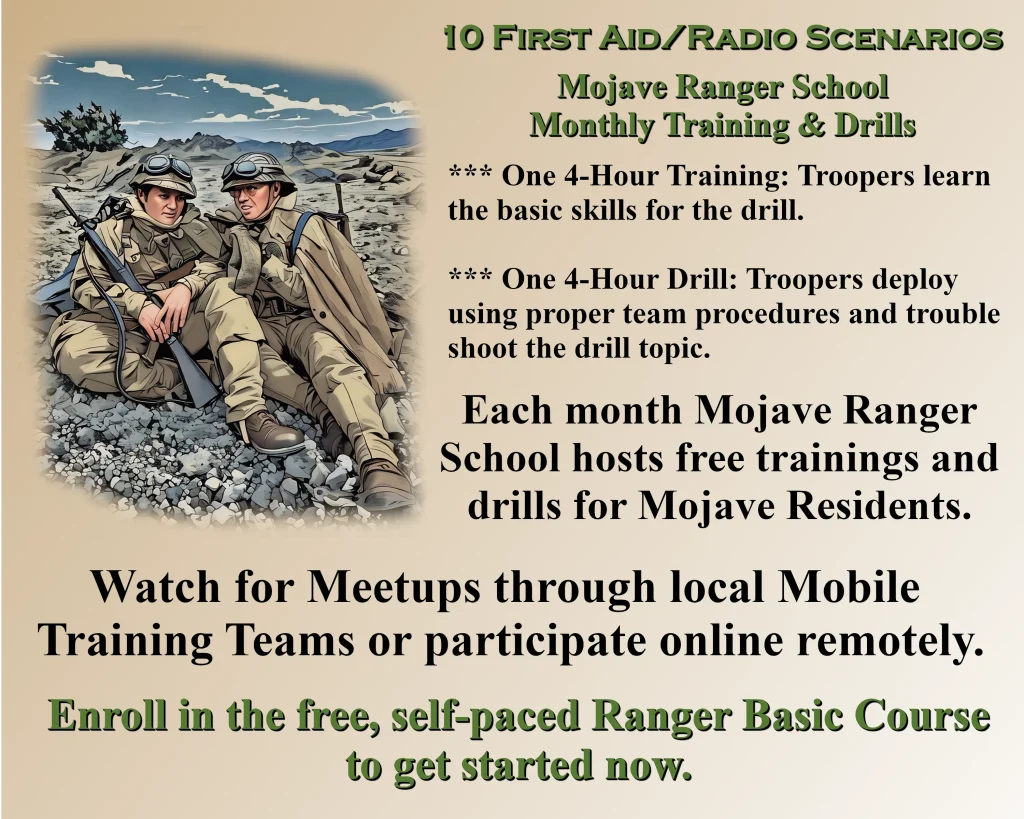
Each monthly training covers blocks from each topic progressively. The first aid, radio and other training for the topics is in the online basic course and should be done by the student before the training day for that topic.
Monthly trainings are not intended to be the training on the topic. Monthly trainings are when the trainees use the skills they studied to work as a team to overcome a mission objective. For instance, the CPR drill is about how to work as a team in a CPR scenario, not individually learn CPR. How to do CPR is covered in the online training.
Trainees can sign off on skills at the monthly drills. The Ranger Basic Task Book is a book of skills checklists for each topic. Trainees demonstrate the skill at the drills and the Instructor signs off on that skill in the trainee’s Task Book.
Each course has an accompanying Task Book. The task books allow trainees with previous military or Emergency Services experience to check off the skills they’ve already learned professionally and focus on what they need for the next rank.
Self-Paced Training
Trainees can join the course at any time of year and don’t have to wait for January to start on the course schedule. Trainings and drills are 4-hours on 2 days each month, but once functional, regular Milsim operations will be happening each weekend at Fort Edwards.
Trainees have the opportunity to train at the fort during on any regularly-scheduled weekend and participate in missions to their level of training and scope of practice.
 5 Training Missions
- Mission 1: Forth and Back – Use a GPS to establish a supply cache in the Mojave. Mission 1 introduces teams to basic mission procedures on a short hike to establish a supply cache.
- Mission 2: The Patrol Base – A Support team works out of a patrol base, which is a small rearward base with additional medics and resources where Ranger Support Teams can extract injured patients to.
- Mission 3: Establish Communications – Establish a radio relay station at a remote Patrol base and run security patrols.
- Mission 4: Radio Triangulation – working from a remote Patrol Base, use ham radio equipment to locate and recover a lost shipment in the desert using radio signal triangulation
- Mission 5: Capture the Flag – Valuable equipment needs to be recovered after a Raider attack. Working from a remote patrol base, find the Raiders, recover the gear and then come home.
 Force-On-Force Training with Plastic BB’s
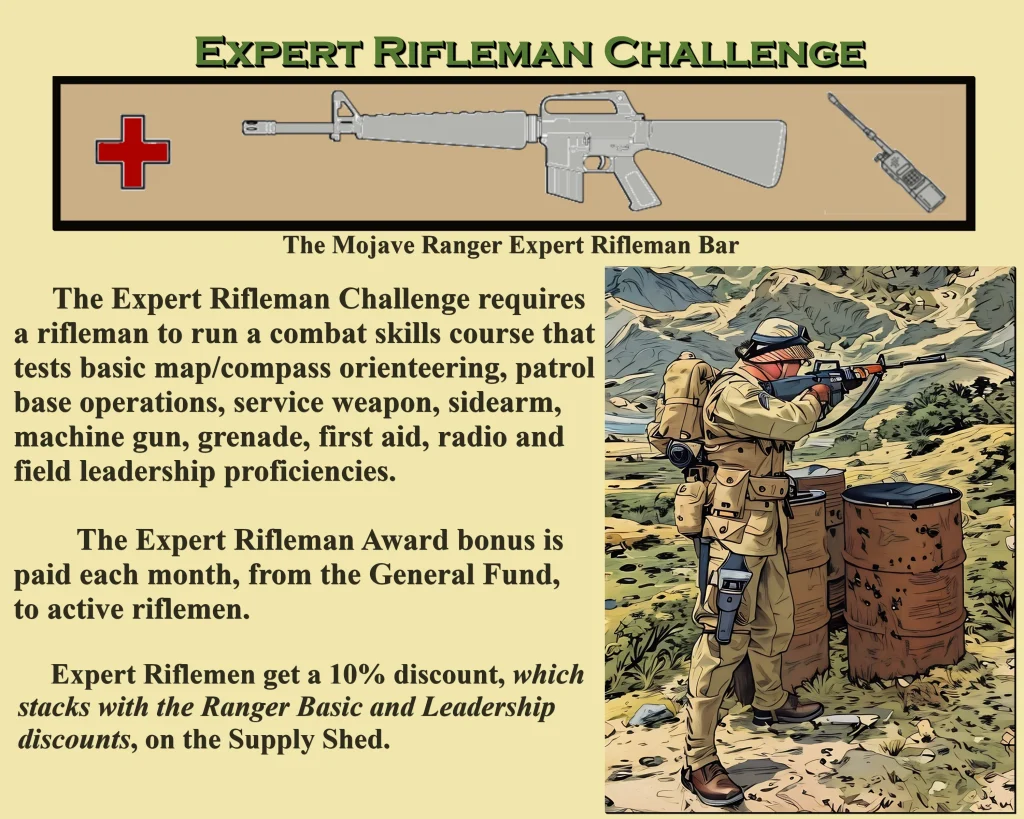
Mojave Ranger School uses airsoft guns and military simulation to create a fully-immersive weekend-long Live-Action Role Play adventure for players. Airsoft guns shoot a 6mm plastic BB at about 400 feet per second, half the speed of a .45 caliber bullet, and it hurts when you get hit.
Players are required to wear proper safety equipment during trainings, drills and live operations and can get seriously injured if they play in an unsafe manner. Using the Crawl-Walk-Run training methodology, trainees learn to slowly and efficiently operate their equipment and work together as a team during progressively harder and faster exercises.
The December Winter Games and YOUHAD (Yearly Operational Unit Holiday Avoidance Drill) are played at full-speed between fully-trained Mojave Rangers with full Force-On-Force operations. YOUHAD a year to get ready for it.
The playing field (the Mojave Desert) is inherently dangerous and your instructors will be hunting you, with BB guns, for bounties, so take the training seriously. Or don’t, you’re the one getting shot at.
The 18 Ranger Warrior Tasks
 The 18 Ranger Warrior Tasks are a specific set of individual skills that the NCR Army considers essential for all troopers to survive and win in combat. While the Army periodically updates these tasks, they are traditionally categorized into four main “Warrior Fighting Functions”: Shoot, Move, Communicate, and Survive.
The current Warrior Tasks and Battle Drills (WTBD), as outlined in the Mojave Ranger Field Manual (FM87-4), include the following 18 essential tasks:
Shoot
- Maintain, employ, and engage targets with an NCR Service Rifle.
- Maintain, employ, and engage targets with a Hi-Power pistol.
- Employ hand grenades.
Move
- Determine grid coordinates of a point on a military map.
- Determine a magnetic azimuth using a lensatic compass.
- Identify terrain features on a map.
- Move over, through, or around obstacles.
- Move under direct fire.
- Perform individual movement techniques (low crawl, high crawl, rushes).
Communicate
- Perform voice communications (using a radio and proper reporting formats like SALUTE).
- Use visual signals (hand and arm signals).
Survive
- Perform First Aid (e.g., applying a tourniquet or treating for shock).
- Perform basic casualty transport.
- React to chemical, biological, radiological, and nuclear (CBRN) attacks/hazards.
- Maintain situational awareness (Everyday Security).
- Select temporary fighting positions.
- Apply camouflage, cover, and concealment.
- Perform noise, light, and litter discipline.
These tasks are taught and tested during Basic Combat Training (BCT) and culminate in field training exercises like the Expert Rifleman Challenge where trainees must demonstrate proficiency to graduate.
Crawl-Walk-Run
The NCR Army uses a “crawl-walk-run” methodology in infantry training to build proficiency and confidence safely. It begins with basic, low-intensity instruction (crawl), advances to tactical exercises with more complexity (walk), and ends with fully immersive multi-day scenarios (run), ensuring skills are mastered before facing combat scenarios.
Crawl Phase (Individual Skills)
- Focus: Basics, fundamentals, and precision.
- Activities: Classroom lectures, dry-fire exercises, and practicing fundamentals without speed.
- Purpose: Building muscle memory for tasks like weapon handling and movement techniques.
Walk Phase (Collective Training)
- Focus: Teamwork, unit communication, and increased complexity.
- Activities: Field training exercises, maneuvering in gear, and using force-on-force training with plastic BB’s to simulate noise and chaos.
- Purpose: Integrating individual skills (from the crawl phase) into team scenarios (e.g., buddy team maneuvers).
Run Phase (Operational Proficiency)
- Focus: High-stress, maximum speed, and realistic combat simulations.
- Activities: Full force-on-force maneuvers, complex scenarios like 11B Infantryman OSUT tasks, and field training exercises.
- Purpose: Ensuring Soldiers can operate in high-stress, dangerous situations, such as live-fire buddy team training.
Key Aspects of the Methodology
- Safety & Mastery: Drill Sergeants use this model to identify deficiencies and mitigate safety hazards before live ammunition is used.
- Repetition: Training repeats at each phase until proficiency is reached, starting over at “crawl” if necessary.