



 The Mojave Ranger Field Manual and the Ranger Basic Course are the instructions for how to play the Mojave Rangers Game locally in your area, and learn the skills to be able to play for real at Ft. Edwards. The Field Manual also includes information on how to start your own Ranger Training Club and how to get paid to help train your friends and family locally in first aid, radio and real-world outdoor skills.
Mojave Rangers: The Game
Mojave Rangers is a Fallout-themed Live Action Role Play game (LARP) that uses tabletop RPG’s and video games as well as milsim and airsoft guns to teach real-world first aid, radio and outdoor skills.
The game is a live-action post-apocalyptic immersive roleplay weekend at a remote fort in the Mojave Desert. It takes special skills just to survive the environment for the weekend.
Rangers, Trainees, Settlers, Refugees and Mojave Residents are welcome to participate in the immersion in their chosen areas to the extent of their training and scope of practice, while the Ranger Troop 4 Good Guys go after the OpFor Raider Bad Guys every weekend.
The Storyline for the Game
Mojave Ranger School uses a post-apocalyptic theme largely based on the Fallout: New Vegas video game. The year is 2287 and the Mojave Rangers are being formed in the western Mojave near the remnants of the old Edwards Air Force Base.
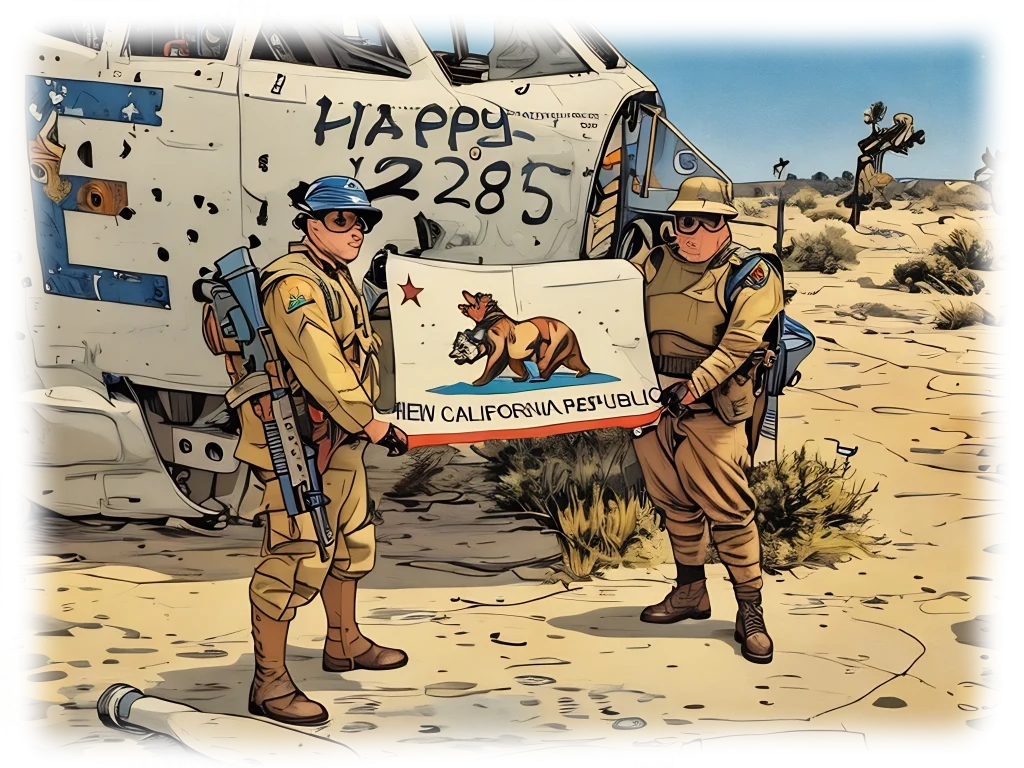 The Mojave Rangers are a group of Mojave settlers who banded together to develop a local law enforcement agency based on the Texas Rangers, in order to bring some order to the local wastelands, based in a small fort on the western edge of the Mojave Desert, called Fort Edwards in honor of the former Air Force base a few miles away.
The Mojave Rangers
The Mojave Rangers are a volunteer civilian law enforcement agency that uses military rank and the pre-war FEMA Incident Command System structure that was used by police and EMS agencies. Mojave Rangers provide first aid and medical assistance where possible, guide and protect medical shipments and doctors and run security patrols.
Mojave Rangers assist with trade route security and Mobile Training Teams. Mojave Ranger Support Teams provide logistics, search & recovery and reinforcements for Ranger and Special Forces operations against raiders, BoS and the Legion in the Mojave.
Mojave Ranger Rifle Teams escort Medic, Radio and Tech Teams on routes throughout the Mojave. The Ranger Rifle & Support Teams maintain a series of medical clinics, radio stations and tech recycling stations along the major trade routes and in various settlements.
Ranger ‘Law Enforcement’: The Lack of Lawyers Almost Makes You Wish for a Nuclear Winter
 Ranger Teams are led by badged Team Leaders and A TL’s who serve as law enforcement officers. However, there is no court system in the Mojave and Fort Edwards is not equipped for managing prisoners or dealing ‘justice’. The Mojave is also surprisingly free of lawyers, who tend to get eaten by things.
Technically the Mojave is under NCR Martial Law. The Ranger LEO Course covers Martial Law and the guidelines under which it’s enforced by Rangers.
Occasionally, raider prisoners for whom rewards are offered are required to be transported by convoy to Camp McCarran. The NCR has rewards for various BoS and Legion officers, which also requires personnel trained for (taking prisoners alive and) prisoner maintenance.
Graduates of the Ranger LEO Course are awarded the Mojave Ranger Badge and serve as the Mojave equivalent of the Texas Rangers. The Ranger LEO is the most highly-trained member of the Mojave Rangers.
While the word ‘Ranger’ is used freely at the Mojave Ranger School, it very specifically applies to the Ranger LEO.
The Ranger
 The Mojave Ranger is a Corporal with the Mojave Ranger Tab, Expert Rifleman Bar, NCO Leadership and Law Enforcement courses. Rangers serve as Asst. Team Leaders on Mojave Ranger Rifle or Support Teams. A Ranger Sargent is in charge of the teams.
The Ranger Basic Course, which is run by the Ranger Troop 4 at Ft. Edwards, is a year-long (self-paced) course that teaches first aid, radios, patrolling, outdoor skills and Mojave Desert survival. Ranger Troop 4 hosts monthly trainings and drills that allow Ranger Basic trainees to sign off on the skills in their task books.
Ranger Basic consists of 10 first aid/radio scenarios and 5 Ranger training missions. Ranger Basic graduates earn the Mojave Ranger Tab and assignment to the Mojave Rangers as a Rifleman Trainee.
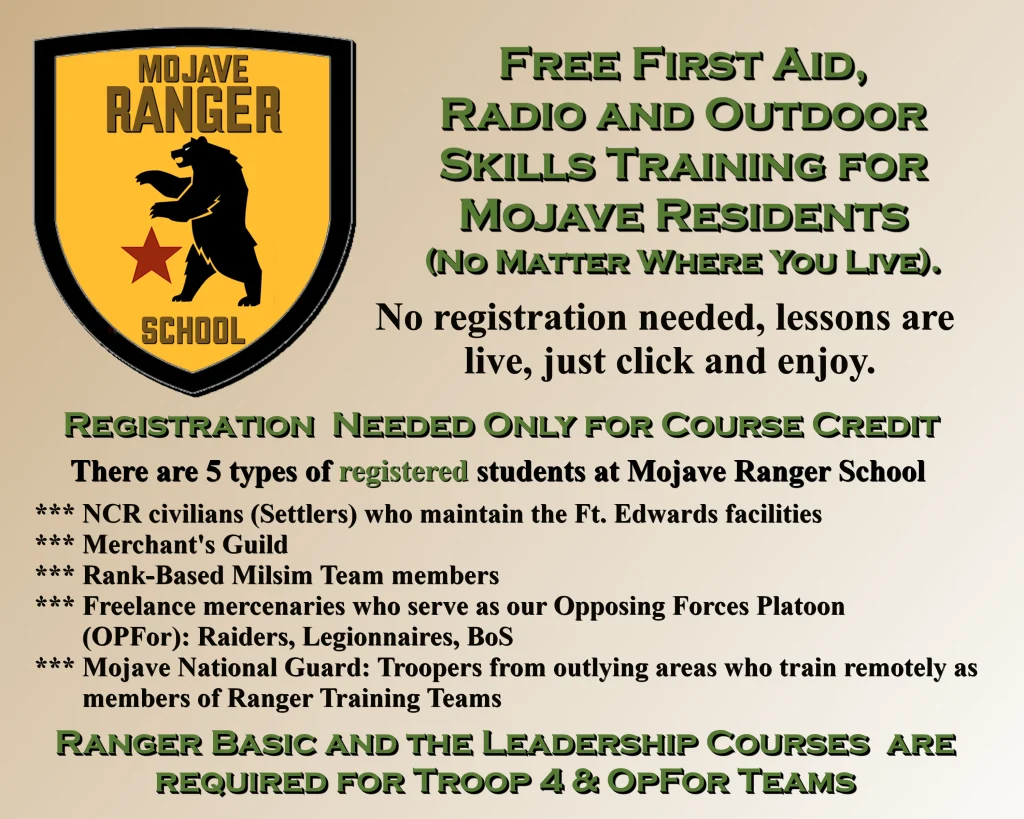 Active Ranger Basic graduates make a monthly bonus from the General Fund and discounts in the Fort Edwards PX + other benefits.
Free Training
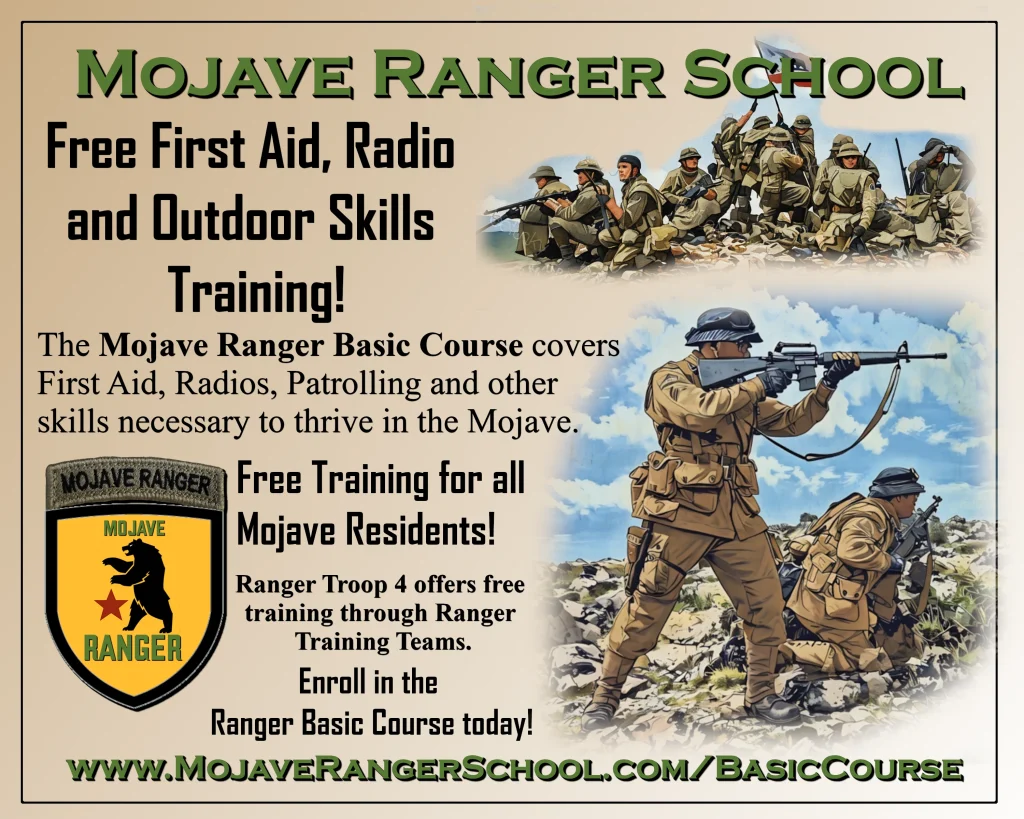
No one pays for basic training at Mojave Ranger School. The Ranger Basic, Leadership, Team Roles and Special Forces training is free and available to anyone who achieves our standards. Basic training at Fort Edwards is free and provided as a public service to ‘Residents of the Mojave’.
Mojave Ranger School is organized similar to a martial arts school. The Ranger Basic Course and the Rifleman team role courses are meant to be taken concurrently. Promotions are based on having skills signed off in your Task Books.
Mojave Ranger School will obviously have to charge for shuttle transportation and there is a nominal fee as an Operations Fund fundraiser for the Bunker B&B’s, which covers water, toilets, MRE’s and other fort logistics.
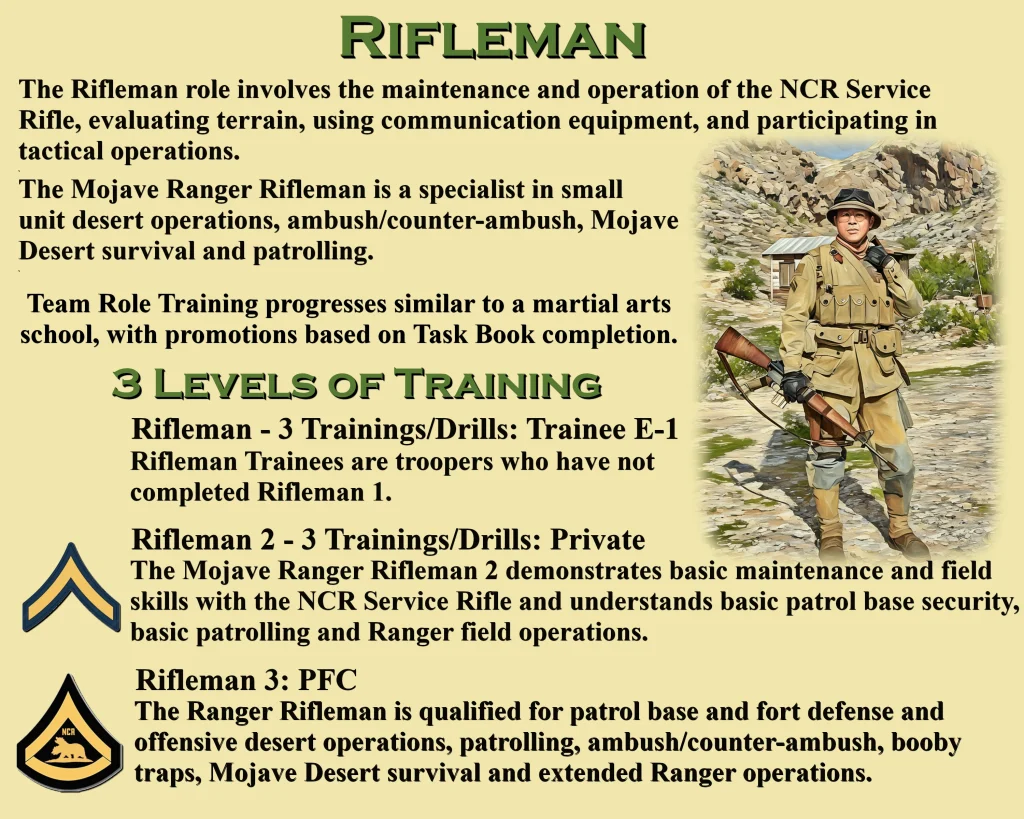 The average martial arts school takes 2-3 years from white belt to Instructor and Mojave Ranger School has roughly the same schedule.
Rangers are the public-facing, day-to-day patrol troops in the Mojave. Rangers volunteer for a year-long training course and volunteer as patrol officers and settlement defenders. It takes about 2 years, on the regular schedule, to become a Ranger. Ranger Basic is 1-year of monthly trainings. Leadership School and the LEO course are an additional 1-year of training.
Launching in Summer 2026
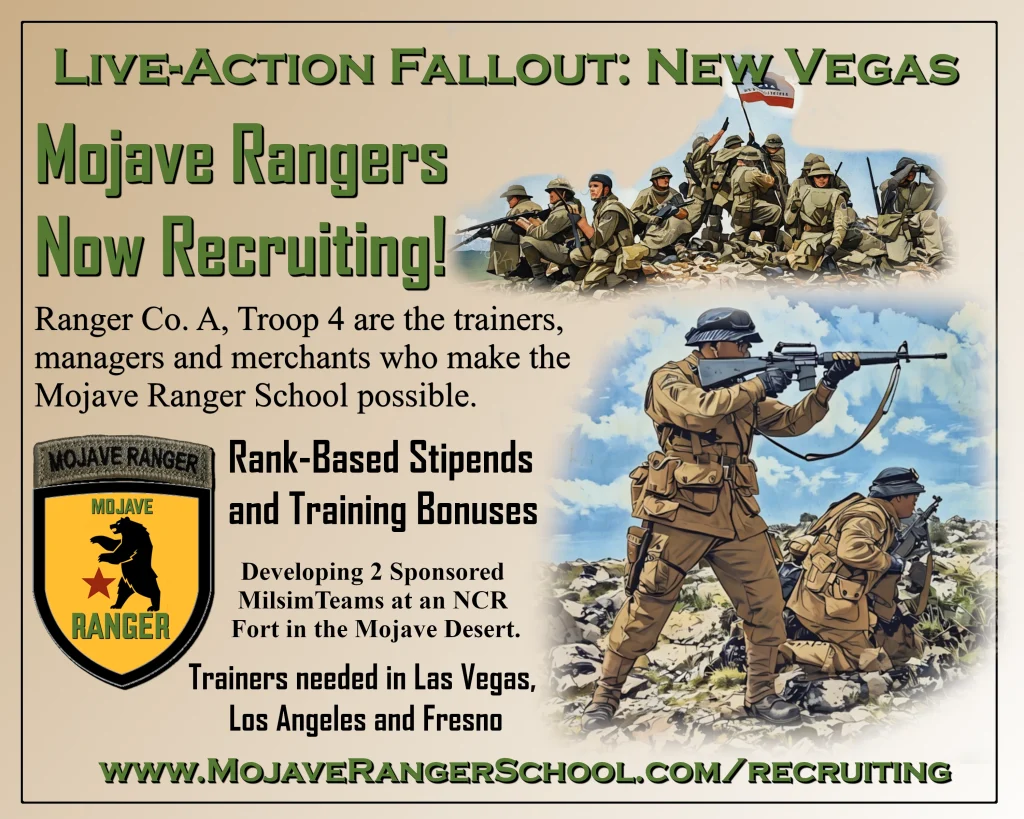 Currently: Mojave Ranger School is developing 2 instructor squads (OpFor3 and Ranger Troop 4) in the Ft. Fresno area. OpFor 3 and Ranger Troop 4 team members are the initial Mojave Ranger School Instructors. Mojave Ranger School uses airsoft guns and military simulation as part of the post-apocalyptic immersion.
For safety reasons, and because we’re not a ‘normal’ Milsim operation, students don’t shoot at students at Mojave Ranger School.
OpFor stands for Opposing Forces, and your instructor’s goal is to train you to be a worthy opponent, which makes it more fun for your instructors to hunt you. OpFor 3 team members serve as the raiders, brigands, Brotherhood of Steel and Enclave bad guys that Ranger Basic students defend against.
The goal for OpFor 3 cadre is to catalyze troopers and settlers to learn the skills needed to defend themselves and their settlements in the Mojave, by hunting them for fun and profit.
 Ranger Troop 4: The Milsim Team
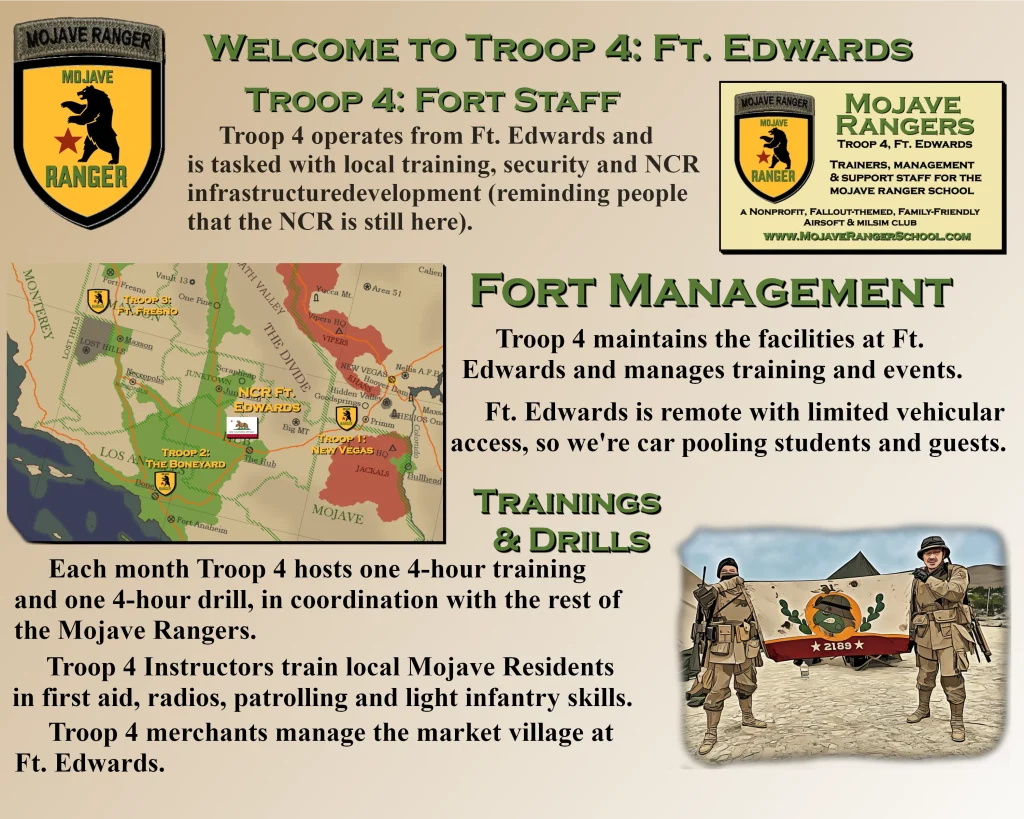
Ranger Troop 4 is a key component of the NCR response to the raider surge in the Mojave. Ranger Troop 4 is ½ of the Ranger School Instructor Team at Ft. Edwards, with OpFor being the other half.
The milism game at Fort Edwards is based around 2 groups of paid instructors who battle each other in an ongoing, persistent, immersive campaign for control of the Mojave. The Ranger training operations support the Ranger Troop 4 operations and the Ranger operations.
Ranger Troop 4 and OpFor also serve as sponsored Milsim teams at airsoft events around southern CA. In addition to recruiting and PR, the Milsim teams give our instructors real-world airsoft battles with other players from around the world. Ranger Troop 4 and OpFor are the ‘Tier 1 Operators’ and the commercial Milsim events are ‘combat deployments’ for the teams.
We can’t pay you play Fallout, but if you help market the system then we can pay you to perform it at events (if you can shoot).




Leave a Reply