


 The Gun Runners are a post-War weapons manufacturer and merchant company rising from small pickings in the Hub to become one of the premier purveyors of armaments in the territory of New California over the span of the 22nd and 23rd centuries, with the military forces of the New California Republic as their biggest customers. Members of the organization are encountered in Fallout and Fallout: New Vegas.
Gun Runners Armory at Fort Edwards
Fort Edwards shopkeepers manage a small Gun Runners Armory at Fort Edwards with a small selection of new and used NCR Service Rifles, Hi-Power and 1911 pistols and various hunting rifles, lever actions and carbines. A Mojave Ranger Armorer assists with repairs and upgrades.
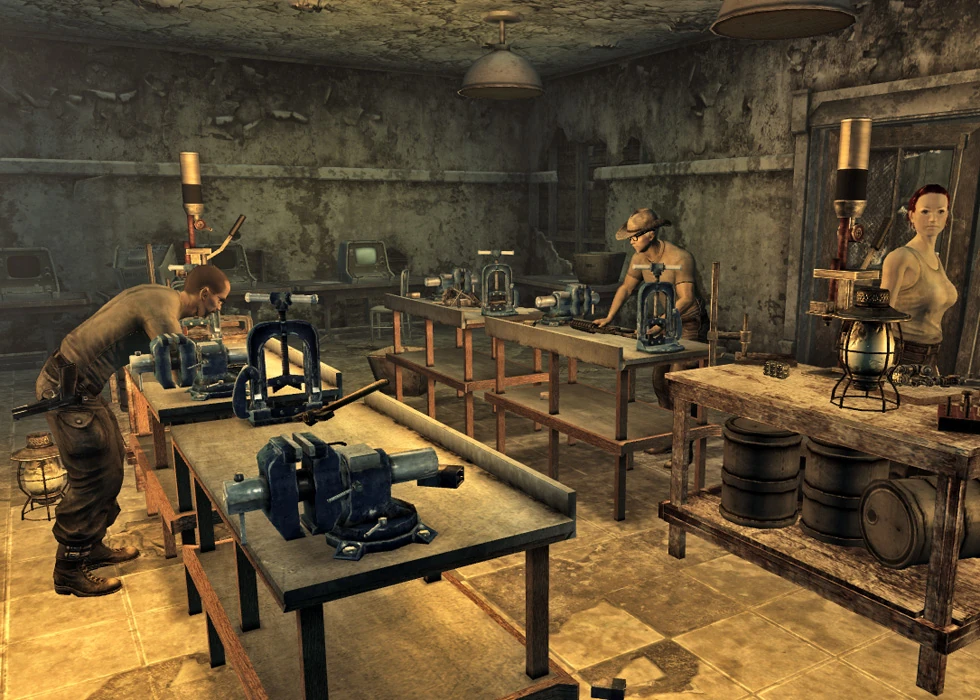 Gun Runners ship products on Mojave Ranger convoys from the Boneyard to Fort Edwards and Camp McCarran and from Fort Edwards and Camp McCarran to the NCR forces in the Mojave.
The NCR Service Rifle
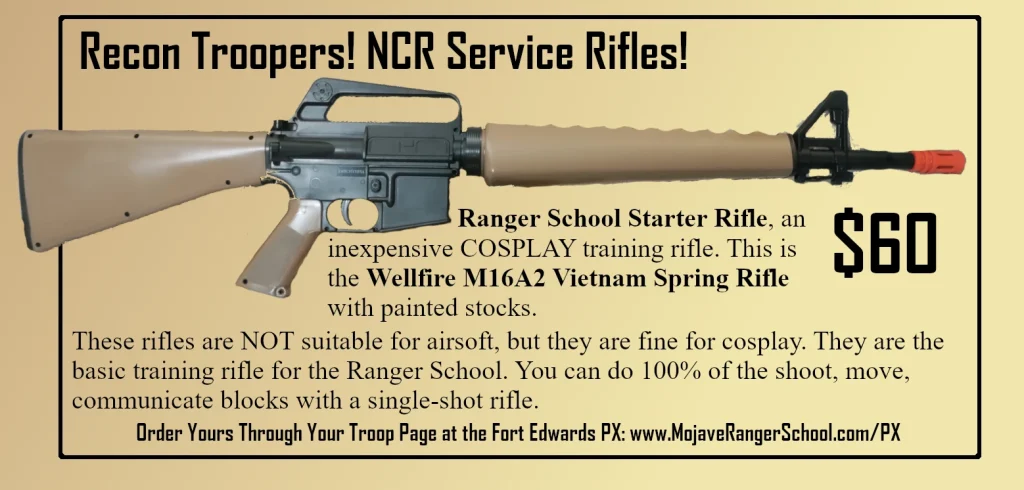
The NCR Service Rifle is pre-War model of lightweight, air-cooled, magazine-fed, gas-operated rifle. Its simplistic assembly design allows for each unit to be easily broken down for cleaning or replacing with a new unit as well as for mass production in times of large-scale military response.
By 2281, the weapon serves as the standard-issue armament of the New California Republic Army. Most service rifles present in the Mojave Wasteland were manufactured pre-War, with the only post-War supplier being the Gun Runners, who also provide post-War production and logistical support for the NCR.
M16A1 with Wooden Stocks
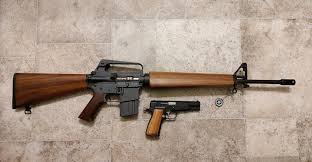 The wooden stocks on the NCR Service Rifle in Fallout: New Vegas are an aesthetic choice reflecting the post-apocalyptic lore: a lack of raw petroleum and injection-molding infrastructure needed to manufacture standard polymer/plastic furniture. [1, 2, 3, 4]
- Resource Scarcity: In the Fallout universe, plastics are incredibly scarce. Hardwood, which can be harvested from reclaimed forests in California, serves as a durable, cheap, and renewable alternative for mass-producing rifle parts.
- Post-War Manufacturing: The service rifle is an Armalite AR-15/M16 derivative that is mass-produced in-house by the Gun Runners and the NCR. Because they lack pre-war factory equipment for casting synthetic polymers, they rely on traditional gunsmithing materials like wood for the stock, pistol grip, and handguards.
- Retro-Futurism: Fallout weapons often feature design cues blending modern mechanics with mid-century or retro aesthetics. Adding wooden furniture to a high-tech modern firearm perfectly fits the wasteland motif.
- Prioritizing the Troops: Because wood is easier to fabricate than specialized aerospace polymers, it makes sense for equipping the standard, wide-spread infantry (grunts) of the NCR Army. Advanced materials are reserved for rare weapons like the Marksman Carbine.
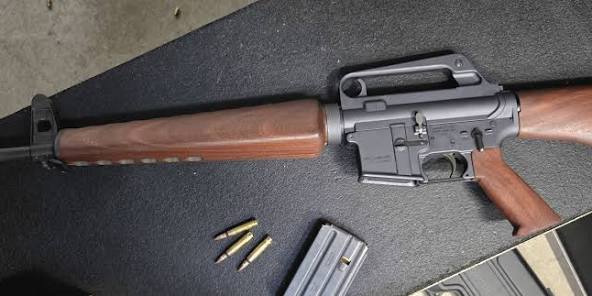 In the Fallout universe, the standard-issue NCR Service Rifle actually features solid wood furniture rather than Bakelite. However, since it is heavily based on the pre-war AR-15/M16 platform, players and replica builders often mix authentic Bakelite or “Fakelite” (faux-Bakelite) components to achieve that specific apocalyptic aesthetic. [1, 2, 3, 4]
- Pistol Grips: You can find original Vietnam-era Bakelite M16A1 grips available through surplus retailers like AKOptions, LLC.
- Handguards: Authentic Bakelite M16 triangle handguards were produced by Colt in the late 1950s but are extremely rare and considered collector’s items. You can occasionally track down original sets on specialized collector storefronts like Retro Rifles.
Mojave Ranger School Service Rifles
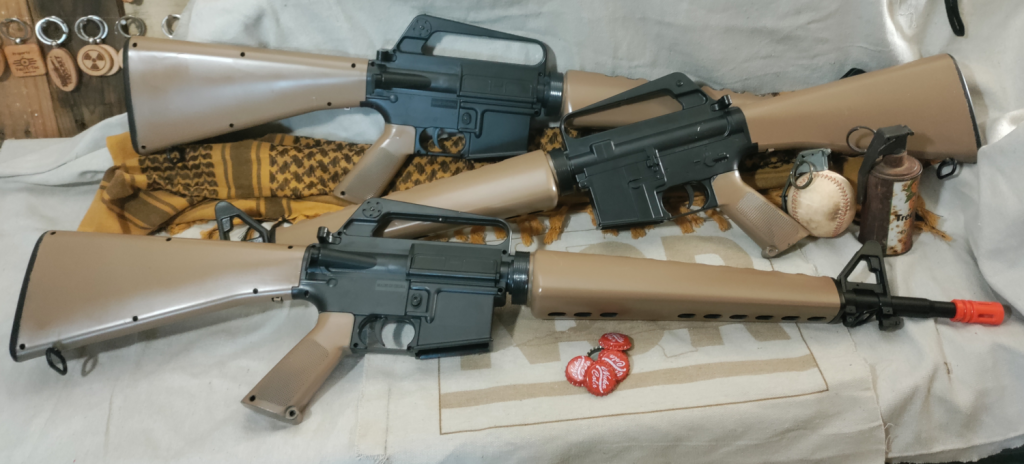
Most Mojave Ranger Service Rifles have either cheaper Bakelite furniture or the original pre-war polymers rather than wood. The fall of the NCR has caused some supply issues for the Gun Runners also and Mojave Ranger School is making do with what we can get for the time being.
Early years in the Boneyard
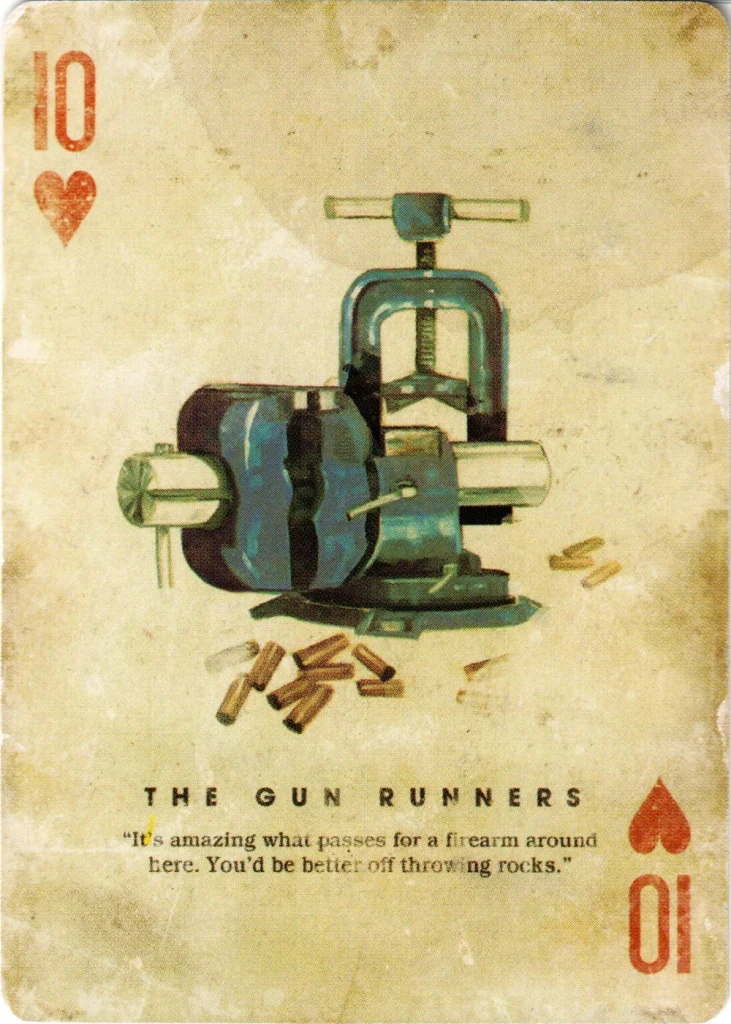 The Gun Runners’ origins can be traced back to a small-time gang from the Hub, before they uprooted and headed south to Angel’s Boneyard (known pre-War as Los Angeles) around 2131. While they did indeed find the promise of new territory to expand their influence, it was not in the way they expected it. In the new territory, the gang settled into an old factory residing in northeast Los Angeles.
On top of their usual gang activities, they started trading weapons taken from their marks or imported from their contacts back at the Hub to the Boneyard’s communities and lesser gangs, though this open trade of weapons to their would-be rivals lead to some viewing the group as having gone “soft” in the dog-eat-dog world of the wasteland.
The cap profits the group made on these deals eventually prompted them to completely shed their gang ties and focus on increasing their power and influence via broadening their trading prospects. Rather than continue importing weapons to match the demand, they decided to put the old machinery inside their factory headquarters to use.
Coupled with an abundant supply of scrap metal in the pre-War ruins surrounding their factory, they quickly established themselves as proficient machinists and gunsmiths, capable of manufacturing weapons and ammunition on par with that of the old United States with the use of preserved pre-War schematics.




Leave a Reply