

Mojave Ranger Station is about 12 miles east of the desert town of Mojave, New California Republic. Mojave Ranger Station is the post-apocalyptic equivalent of an Old West fort, with 1 Ranger Troop that actively patrols the area and assists local residents with training, defense, medical and tech services.
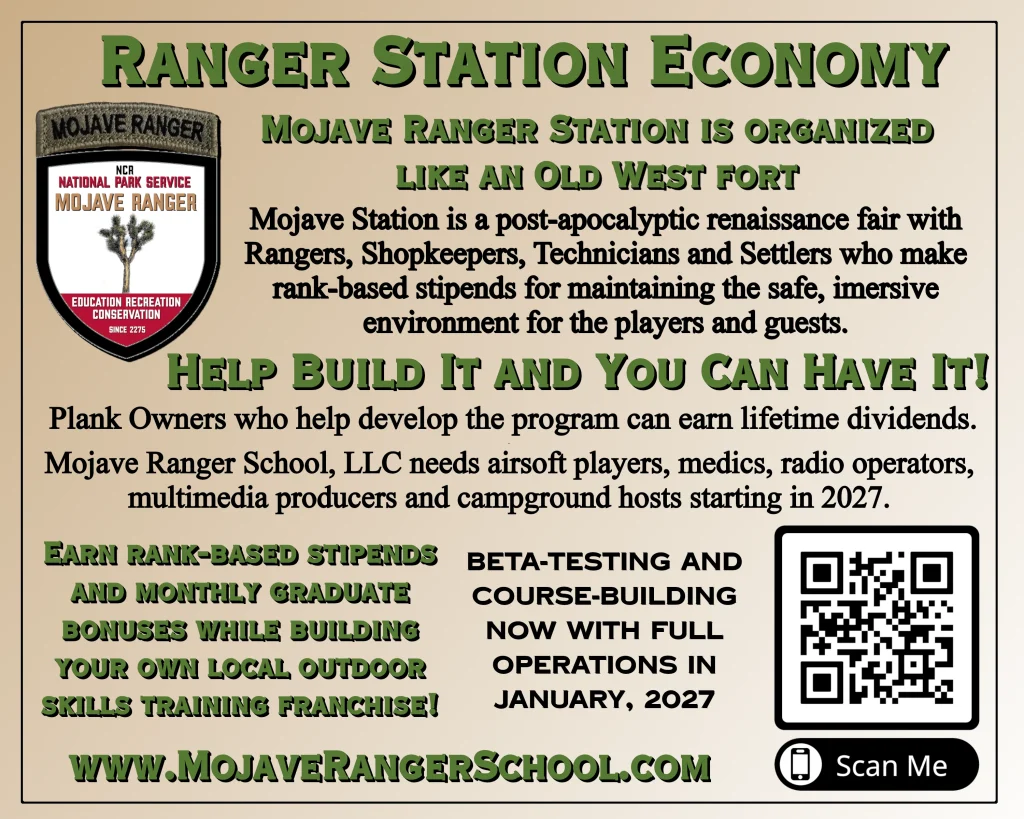 Developing an Economy for the Station: Like an Old West Fort
The project goal is to give free camping and training for club members while providing stipends and commissions for trainees and their families, rather than to make money off memberships and camping fees. Vista de Nada has a variety of income sources,
- Each of the shops in Vista de Nada pays a small rent to the club, which helps cover water, sanitation and operating expenses.
- 80% of the Bunker B&B and glamping cabins proceeds goes to the club for operating expenses.
- Vista de Nada can host a variety of events and small-scale Fallout fan celebrations.
The Economy of an Old West Fort
The economy of an Old West fort relied on a cash-strapped military payroll, high-cost freight logistics, and localized bartering. Whether functioning as a private fur-trading post like Bent’s Old Fort National Historic Site or a federal army garrison, these remote outposts served as regional economic lifelines that exchanged manufactured goods for raw commodities, labor, and livestock.
Core Economic Drivers
-
The Sutler’s Store: A licensed private merchant inside a military fort sold tobacco, coffee, and dry goods at inflated prices, capturing soldiers’ meager monthly pay—often just $6 to $13 for privates—via a credit and ledger system.
-
Freight and Logistics Inflation: Transporting heavy goods like nails, tinware, and flour by wagon across hundreds of miles of open trail meant prices were dictated by weight and extreme transit risk rather than base value.
-
The Fur and Hide Trade: Private frontier posts functioned primarily through barter, trading metal tools, firearms, and cloth to trappers and Native Americans in exchange for beaver pelts and buffalo robes.
-
Regional Stimulus: Federal construction contracts, annual beef/grain procurement, and payroll injections sparked localized economic development, encouraging surrounding civilian towns, freighters, and cattle ranchers to anchor nearby.
Marketing to the NCR
In the fictional, post-apocalyptic Fallout world being re-enacted in advance, the New California Republic (NCR) had nearly a million residents when the government started crashing. The Mojave National Park was intended to develop economic stimulus for the area by encouraging tourism, education and commerce along the trade routes between New Vegas, the Boneyard and Fort Fresno.
The Vista de Nada General Store catalog gets marketed to the NCR (and everyone else) to help encourage outside commercial cash flow into the area while providing a sales outlet for wasteland artists and vendors. The Vista de Nada market square provides a central distribution and fulfillment point.



Leave a Reply