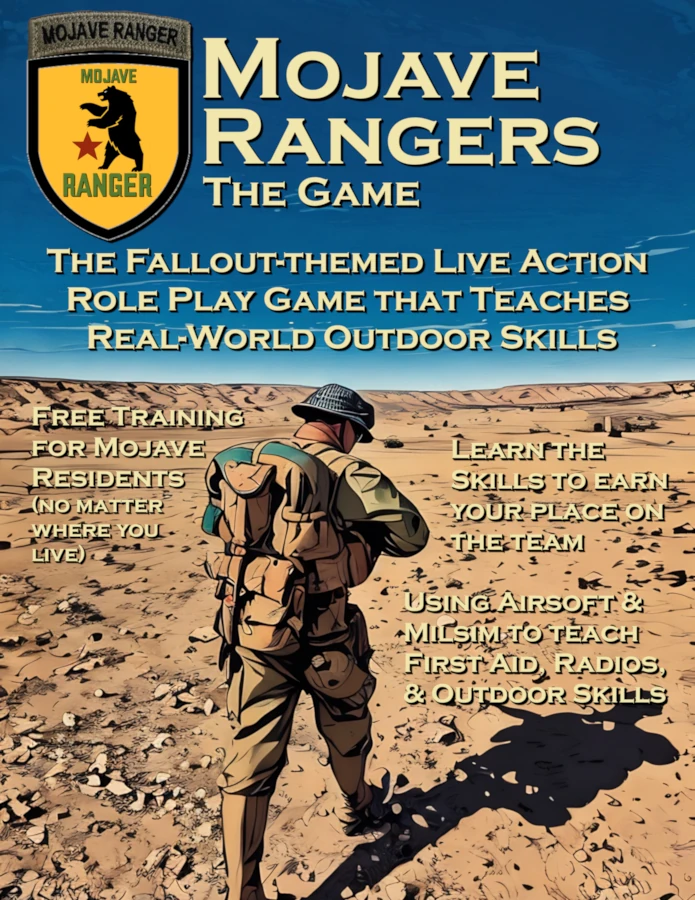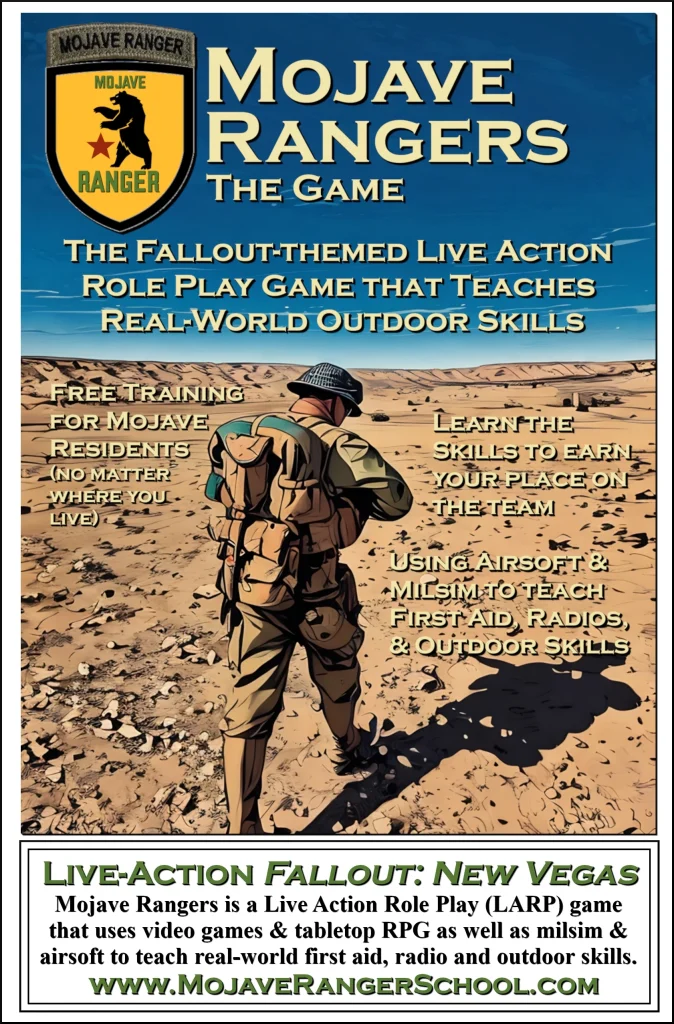
The Mojave Rangers Game Booklet is four 8.5×11 pages printed front and back and then folded like a 60’s church newsletter. The game booklet has the basic description of the game, the history and lore and details about 4th Ranger Bn and the Mojave Rangers.
The game booklet is meant to be downloaded and printed locally by Ranger Training Teams, Gun Runners and Guild Merchants to advertise the game through their local comic book and game stores and other events.
The Mojave Rangers game is free to play and the Ranger Basic Course is free both at Fort Edwards and through local venues.
Pre-printed and stapled copies of the game booklet are available in bulk for Ranger Training Teams, Gun Runners and Guild Merchants who are attending comic cons and Fallout fan events.
Modular Inserts
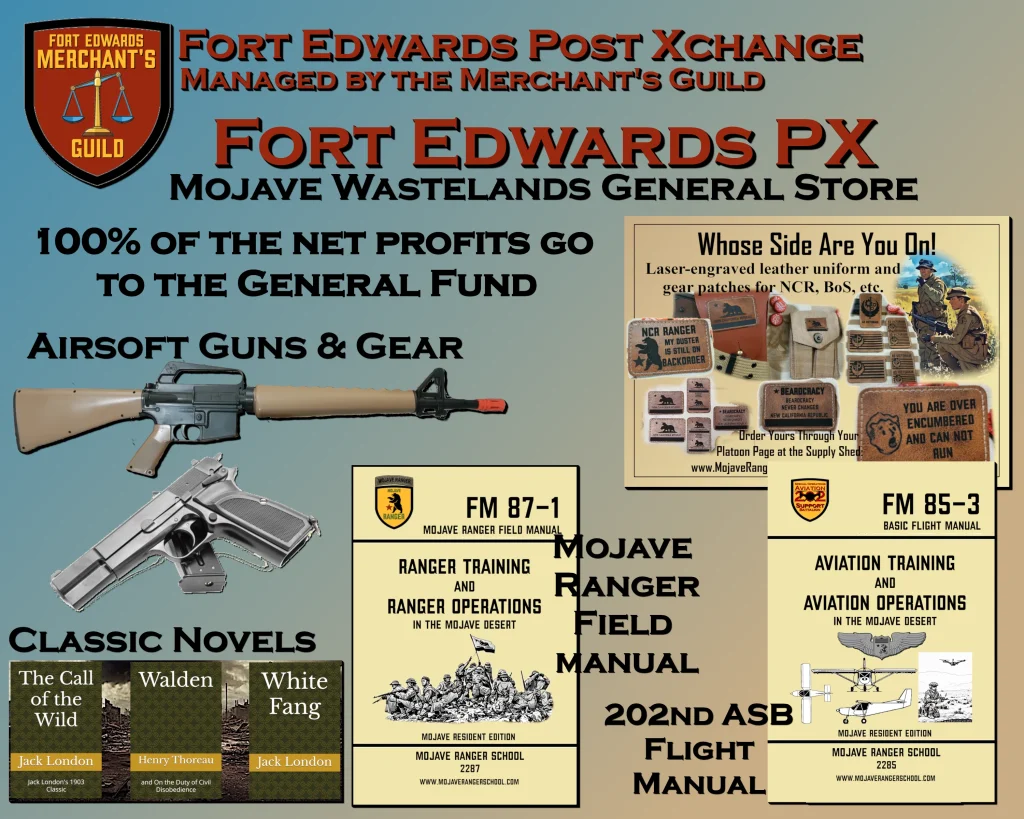
- Fort Edwards PX puts out a monthly 1-page front and back foldable catalog insert with the month’s sales and new items
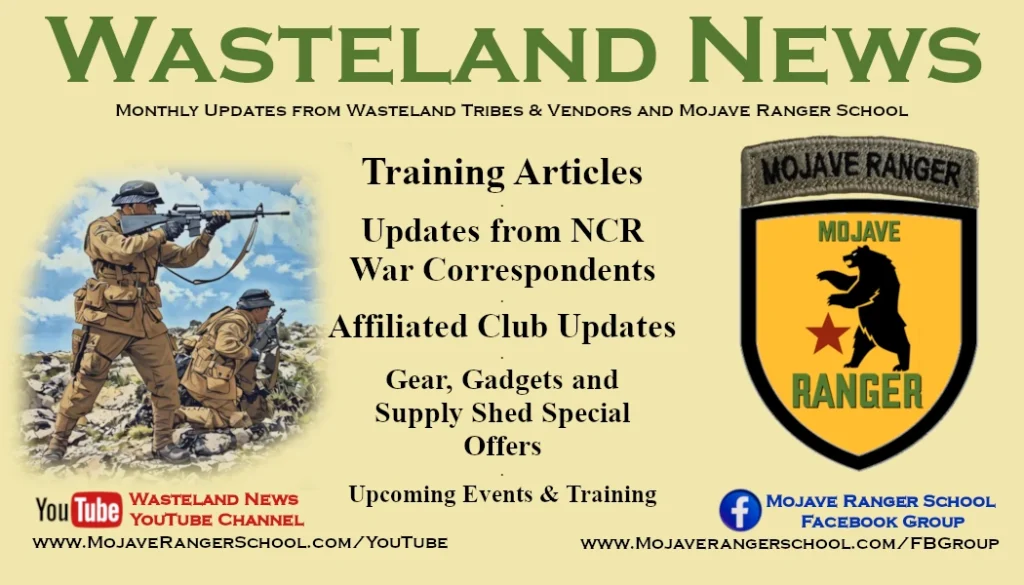
- Wasteland News issues monthly news alerts for Wasteland events and news.
The game booklet and inserts can be downloaded here,
- Inner & Outer Cover: https://mojaverangerschool.com/gamebooklets/cover
- Page 2: https://mojaverangerschool.com/gamebooklets/page2
- Page 3: https://mojaverangerschool.com/gamebooklets/page3
- Page 4: https://mojaverangerschool.com/gamebooklets/page4
- Summer Fort Edwards PX insert
- Summer Wasteland News insert
Game Story Line
In the Fallout: New Vegas video game Shady Sands, the capitol city of the New California Republic (NCR), was destroyed in a surprise nuclear attack in 2283, shortly after the 2nd Battle of Hoover Dam.
The Mojave Rangers are a group of civilian volunteers, based on the pre-war Texas Rangers, who provide
security, medical and tech services in the western Mojave. When Shady Sands fell the NCR was approving the Mojave Rangers as the 4th Ranger Battalion, NCR Army Reserve, and authorizing an NCR fort in the western Mojave as the Mojave Ranger official base…but then all record of the authorization was apparently lost in the blast.
The 4th Ranger Bn is still developing (in bureaucratic limbo) while the NCR leadership ‘reorganizes’ and re-approves the funding and equipment. Bearocracy, Bearocracy Never Changes.
While the fall of Shady Sands has thrown the NCR government into flux and upheaval, the military units in the Mojave are, for the most part, continuing to operate as consistently as possible within NCR Martial Law and providing Continuity of Local Authority.
Continuity of Local Authority consists of maintaining NCR operations until the NCR leadership gets its stuff together, which is the same as it ever was, in the Mojave.
The Mojave Campaign
The Mojave Campaign, also known as the Pacification of the Mojave, is an NCR military offensive, beginning in 2253, with the objective of annexing the entire Mojave Wasteland.
The campaign erupted after the massacre of 38 NCR citizens at the hands of Mojave raiders in 2253. President Wendell Peterson ordered three battalions of NCR infantry into the Mojave, beginning the campaign.
The campaign’s initial intent was to pacify all raider forces to make safe headway for NCR citizens, but has since shifted the aim to remain in control of the Hoover Dam and prevent Caesar’s Legion from advancing across the Colorado River and in turn, from endangering the Republic to the west.
The Campaign
To secure transportation routes from the Mojave to the NCR in the west, the Mojave Outpost was established in 2272. As early as 2273, the New California Republic sent Rangers out east to scout for anything of interest.
The Rangers discovered that the pre-War city of Las Vegas (now renamed “New Vegas”) had been relatively untouched by the Great War and that Hoover Dam was in repairable condition. The NCR quickly sent a detachment to take control of the New Vegas region in hopes of using the rich resources there to their advantage.
The NCR, after having moved in the Mojave area, seized other nearby areas such as Bullhead City in what came to be known as the “Pacification of the Mojave.” Once they were able to mobilize a sizable force, the NCR occupied the Hoover Dam.
With the Treaty of New Vegas, the NCR was given control of Hoover Dam and the NCR deployed military forces in the region. NCR citizens can visit the Strip without interference but have to recognize New Vegas independence.
Rise of the Mojave Raiders
In 2280 the 1st Recon scouts began encountering packs of highly-trained, well-armed raiders who were attacking NCR resources under leadership of what appear to be Brotherhood of Steel and Caesar’s Legion advisors.
The NCR response was to authorize a local civilian volunteer Ranger group as the 4th Ranger Battalion, NCR Army Reserve, and use the 4th Rangers to staff a series of forts in the Mojave to train local citizens to defend themselves.
The 4th Ranger Bn would run trade route security convoys from a base fort in the western Mojave to New Vegas, the Boneyard and Fort Fresno.
The 4th Ranger Bn would consist of 1 Ranger Training Troop in each outpost with an operational Troop at Fort Edwards.
Free Basic Training for NCR Troopers and Mojave Residents
In some cases, NCR troopers were deployed to the Mojave with as little as 2 weeks training. The 4th Rangers provide free monthly training and drills for NCR troopers as well as Mojave residents who want to help defend and maintain their settlements.
Opposing Forces
Mojave Ranger School is developing an instructor squad (OpFor Squad 3) in the Ft. Fresno area. OpFor 3 team members are the initial Mojave Ranger School Instructors. Mojave Ranger School uses airsoft guns and military simulation as part of the post-apocalyptic immersion.
For safety reasons, and because we’re not a ‘normal’ Milsim operation, students don’t shoot at students during exercises at Mojave Ranger School.
OpFor stands for Opposing Forces, and your instructor’s goal is to train you to be a worthy opponent, which makes it more fun for your instructors to hunt you.
OpFor 3 team members serve as the raiders, Brotherhood of Steel and Enclave bad guys that Ranger Basic trainees defend against.
The goal for OpFor 3 cadre is to train troopers and settlers in the skills needed to defend themselves and their settlements in the Mojave.
Basic Training in the Mojave Desert
The Mojave Desert is one of the toughest training environments on Earth, with searing day-time temperatures and freezing nights. Mojave Desert survival is as important as weapons and communications training because the desert itself will kill troopers faster than the raiders or insurgents.
The Mojave Ranger School
While the Mojave Ranger School isn’t a regular NCR Basic Training facility, the instructors can check off the skills in the task books for NCR troopers who participate in the training.
NCR Troopers who complete the Ranger Basic Course are authorized to wear the Mojave Ranger Tab and may qualify for a transfer into the 4th Ranger Bn for further training and assignments in the Mojave.
Free Training
Mojave Ranger School is organized similarly to a martial arts school. The Ranger Basic Course and the Rifleman team role courses are meant to be taken concurrently. Promotions are based on having skills signed off in your Task Books.
Mojave Ranger School will obviously have to charge for shuttle transportation and there is a nominal fee as an Operations Fund fundraiser for the Bunker B&B’s, which covers water, toilets, MRE’s and other fort logistics.
The average martial arts school takes 2-3 years from white belt to Instructor and Mojave Ranger School has roughly the same schedule.
Ranger Basic Course
The Ranger Basic Course is a year-long Milsim training course that trains medics and radio operators from a fort in the Mojave Desert. Ranger Basic has 3 phases,
Fort Phase: the first 3 trainings and drills are at Fort Edwards and cover basic team procedures, Milsim procedures, Mojave Desert survival and squad equipment proficiency. Trainees are promoted to Private (E-2) after the Fort Phase.
Patrol Base Phase: the second 3 trainings and drills cover patrol base operations. Trainees operate away from the fort on radio relay stations and support bases. During the Patrol Base Phase trainees learn to bivouac away from the fort and operate during the dawn and dusk hours (crepuscular, like coyotes) and rest and train during the heat of the day. Trainees are promoted to Private First Class (E-3) after the Patrol Base Phase.
SAR Phase: During the Search & Rescue Phase trainees learn to operate with either Ranger Troop 4 or OpFor and participate in the weekend operations at Fort Edwards. SAR Phase includes night operations from a patrol base or the fort. After the SAR Phase trainees can attempt the Expert Rifleman Challenge and earn the Expert Rifleman Bar, and bonus.
Self-Paced Training
Trainees can join the course at any time of year and don’t have to wait for January to start on the course schedule. Trainings and drills are 4-hours on 2 days each month, but once functional, regular Milsim operations will be happening each weekend at Fort Edwards.
Trainees have the opportunity to train at the fort during on any regularly-scheduled weekend and participate in missions to their level of training and scope of practice.
5 Training Missions
- Mission 1: Forth and Back – Use a GPS to establish a supply cache in the Mojave. Mission 1 introduces teams to basic mission procedures on a short hike to establish a supply cache.
- Mission 2: The Patrol Base – A Support team works out of a patrol base, which is a small rearward base with additional medics and resources where Ranger Support Teams can extract injured patients.
- Mission 3: Establish Communications – Establish a radio relay station at a remote Patrol base and run security patrols.
- Mission 4: Radio Triangulation – working from a remote Patrol Base, use ham radio equipment to locate and recover a lost shipment in the desert using radio signal triangulation.
- Â Mission 5: Capture the Flag – Valuable equipment needs to be recovered after a Raider attack. Working from a remote patrol base, find the Raiders, recover the gear and then come home.
Fort Edwards Settlement Team
The Fort Edwards Settlement Team are the campground hosts, vendors, artists, musicians and Mojave Rangers who maintain the safe, immersive environment for the other guests, vendors and outdoor skills trainees who attend Ft. Edwards.
Fort Edwards Shops and Businesses
Fort Edwards isn’t designed for large-scale Renaissance Fair-type events. The Market Square is designed for the enjoyment of Fort Edwards visitors, as a showcase for Wasteland vendors, artists and musicians who take advantage of the Fort Edwards Merchant’s Guild.
The Market Square has several permanent shops in 10×12 sheds with 10×12 courtyards for demonstrations and displays,
• Gute-N-Berg Laser Engraving is an Old West-style laser engraving shop that makes maps, wanted posters and other items, managed by a Shopkeeper.
• The Gun Runners Armory is an airsoft shop which sells and repairs new and used airsoft guns.
• The Fort Edwards PX is the Fort Edwards General Store.
• Fort Edwards has several boutique shops that carry an assortment of goods from Merchant’s Guild vendors who aren’t at the fort, managed by Shopkeepers.
Shops at Fort Edwards can be leased by the weekend or the month, and include an accompanying cabin in the village.
Fort Edwards Merchant’s Guild
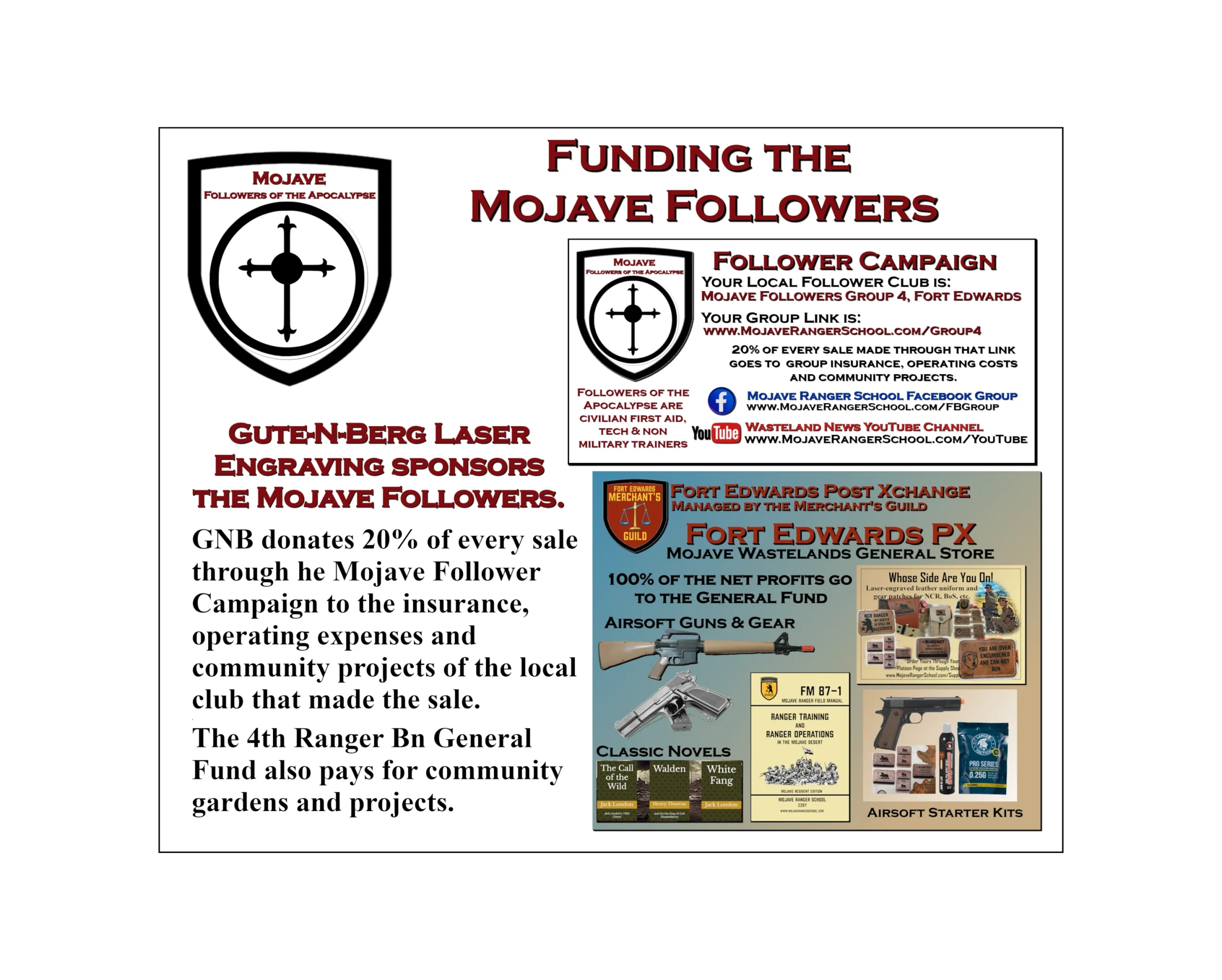
The Merchant’s Guild are the Wasteland vendors, artists and craftsmen who add their products to the Fort Edwards PX catalog. The product sales are a way to develop some cash flow for the staff who are helping manage the programs as well as pay for real-world expenses like toilets and insurance.
Part of each sale goes into the General Fund and each month our staff get rank-based stipends based on club success, so as the school grows, so will the stipends.
Wasteland vendors whose products are carried through the Ranger School Fort Edwards PX get more exposure for their products, directly to their target demographic.
Ranger Training Club Requirements
- Training: Ranger Training Clubs are required to participate in Mojave Ranger School’s training and drill days (4 hours, twice a month), which will be available on Zoom and YouTube as soon as possible.
- Radio/Comm Nets: Ranger Training Clubs are required to participate in the monthly radio/comm nets as equipment permits
- ‘The 8 Forms’: Bearocracy: Bearocracy Never Changes. Ranger Training Clubs are required to use and maintain The 8 Forms used by Mojave Ranger School for student safety and accountability.
- Club Safety Rules: Ranger Training Clubs are required to maintain safe, immersive environments which include,
no live weapons or ammunition, ever - no discrimination, bullying
- no excessive alcohol or drug use
- no modern politics, religion or sexuality-based stress, for anybody.
- Maintain a safe, family-friendly environment
- Club Insurance: Mojave Ranger School with soon have a liability insurance policy that covers activities by Ranger Training Clubs during official events, and pays for your insurance through the General Fund.
Troop 4 and Opfor: Sponsored Milsim Teams
Ranger Troop 4 is a key component of the NCR response to the raider surge in the Mojave. Ranger Troop 4 is developing 1 Rifle and 1 Support Team at Fort Edwards as a Ranger Troop 4. Ranger Troop 4 is ½ of the Ranger School Instructor Team at Ft. Edwards, with OpFor being the other half.
The Milsim game at Fort Edwards is based around 2 groups of sponsored instructors who battle each other in an ongoing, persistent, immersive campaign for control of the Mojave. The Ranger training operations support the Ranger Troop 4 operations and the Ranger operations.
Ranger Troop 4 and OpFor also serve as sponsored Milsim teams at airsoft events around southern CA. In addition to recruiting and PR, the Milsim teams give our instructors real-world airsoft battles with other players from around the world.
We can’t pay you play Fallout, but if you help market the system then we can sponsor you to perform it at events.


Leave a Reply